


The Hidden Warehouse Hiding in Your Yard: A Fresh Look at Sheltirx Storage Shelters and Flexible Space
- Sheltirx Fabric Building
- 3 hours ago
- 6 min read

The Yard-to-Warehouse Revolution: Why a Sheltirx Storage Shelter Could Be the Smarter Move in 2026
A business yard can start out with plenty of room. Then equipment arrives, inventory grows, vehicles need protection, materials pile up, and suddenly that open space you once thought was generous has quietly turned into an unofficial warehouse—minus the roof.
It's a situation that comes up constantly across industrial, agricultural, construction, logistics, and equipment-heavy operations. And the question isn't always whether a company needs more storage. More often, it's how to create useful covered space without jumping straight into a conventional permanent building.
That's where a modern storage shelter starts to look like an interesting alternative.
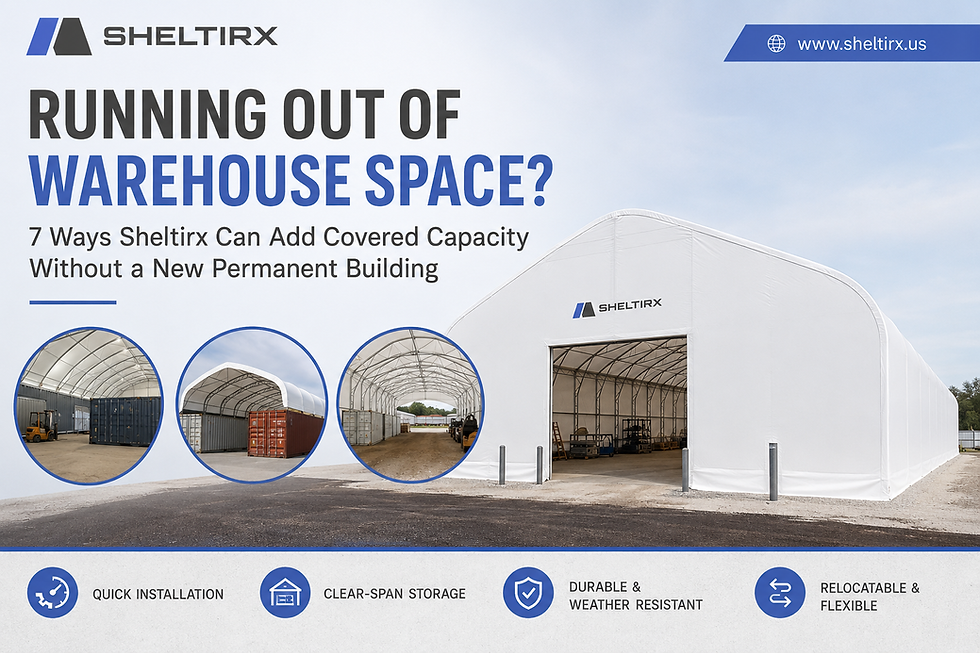
Sheltirx, founded in 2016, provides fabric buildings, container canopies, temporary warehouses, and industrial storage shelters built around flexibility and practical site requirements. The company's current website says it delivers hundreds of fabric structures and installations globally each year, and designs its structures around area-specific wind and snow loads, local codes, or the International Building Code (IBC).

When Your Yard Quietly Becomes Your Warehouse
Outdoor storage seems convenient enough at first. Put equipment outside, stack materials along a fence, park vehicles wherever there's room, deal with the rest later.
But "later" tends to get expensive.
Rain, snow, UV exposure, wind, dust, and shifting temperatures all make outdoor storage harder to manage. Materials end up needing extra protection, equipment needs more frequent attention, and employees spend more time just moving things around a disorganized yard.
Then there's the operational side of it.
A yard designed mainly for vehicle movement isn't automatically a good warehouse. Once storage starts creeping into traffic lanes, loading areas, maintenance zones, or access routes, the problem becomes bigger than simply running out of space.
A covered structure can carve out a defined area for equipment, inventory, bulk materials, vehicles, or work activities, freeing up the rest of the yard to function the way it's supposed to.
Could a Sheltirx Storage Shelter Be the Better Option?
The answer depends on the site, but Sheltirx storage shelters are specifically positioned as temporary warehouse solutions for organizations that need extra room without committing to a permanent build.
That distinction is worth sitting with.
A storage shelter doesn't have to mean a flimsy temporary tent. Sheltirx says its structures use hot-dip galvanized steel frames and PVC/PVDF/PTFE fabrics, built to perform for years and often decades. The company also leans heavily on relocatability, letting structures be dismantled, moved, extended, or reconfigured as needs shift.
For a growing business, that flexibility is genuinely useful.
Instead of asking "where can we build a permanent warehouse?", it's sometimes more useful to ask "what covered space do we need right now, and how might that need change later?"
The Difference Between a Container Canopy and a Storage Shelter
Not every yard needs the same fix.
Sheltirx itself draws a line between container canopies and larger storage shelters. Its website explains that a container canopy makes sense when ISO shipping containers are already on site, while storage shelters suit larger clear spans, enclosed sides, or warehouse-style storage better.
That gives businesses a decent starting point.
A container canopy can turn existing containers into part of a covered working or storage area. Sheltirx's 40 × 20 ft container canopy, for example, provides 800 square feet of sheltered space between shipping containers and uses a hot-dip galvanized double-truss steel frame with a heavy-duty 25oz PVC cover.
For larger operations, a dedicated storage shelter opens up considerably more space.
The Sheltirx 60ft Industrial Storage Shelter is listed with 7,200 square feet of clear-span storage and 25-foot eaves clearance, built for industrial, agricultural, and logistics applications where heavy machinery, tall storage, or bulk materials need substantial unobstructed room.
These are different tools for different jobs, not competing products aimed at the exact same situation.
Why Clear-Span Space Can Change Yard Operations
One of the biggest advantages of a clear-span storage structure is simply the usable floor area.
Traditional interior columns get in the way of vehicle movement, equipment positioning, pallet storage, and machinery access. A clear-span design cuts out those internal obstructions, so you can organize the space around your operation instead of around the building itself.
For businesses storing large equipment, bulk materials, vehicles, agricultural machinery, or industrial components, that difference can be significant in practice.
The goal isn't just to put up a roof.
It's to create space you can actually use.
Speed Matters When Storage Problems Are Already Affecting Operations
A conventional permanent building takes real time: planning, design, site prep, construction, coordination.
Fabric storage structures offer a different path.
Sheltirx describes its storage shelters as solutions that can add working space in a matter of days. Individual product specs vary, but the company's 20ft-series industrial storage shelter, for instance, lists a typical installation time of 2–3 working days with lifting equipment for that configuration.
Actual timelines will depend on site conditions, structure specifications, installation requirements, and other factors.
That speed matters because storage shortages rarely wait around for a convenient construction schedule.
If equipment is already sitting outside, inventory is already eating into your yard, or a project needs more covered capacity now, faster deployment has real operational value.
Relocatability Is More Than a Marketing Phrase
Business needs shift.
A construction project wraps up. A logistics operation expands. A farm buys more equipment. A company redesigns its yard layout. A "temporary" project becomes long-term. A long-term requirement moves somewhere else entirely.
A permanent building doesn't move with any of that.
Sheltirx structures are built around a different idea: relocatability.
The company says its modular structures can be dismantled and reinstalled with minimal downtime, letting businesses move or reconfigure covered space as requirements change.
That makes a storage shelter especially appealing for businesses that value flexibility over permanence.
The structure becomes part of the company's infrastructure without being permanently welded to one location.
Built Around the Site, Not Just a Standard Box
Customization is another piece of the puzzle.
Every yard is different—different dimensions, access routes, equipment, weather conditions, operational quirks. A one-size-fits-all structure doesn't always fit.
Sheltirx says it supports customization around span width, height, door placement, lighting, and other project-specific requirements, and that its structures can be engineered around site-specific wind and snow loads and applicable codes.
Which means the planning should really start with the site itself.
What's actually going to be stored in there? How tall is the equipment? Where do vehicles need to enter and exit? Does it need enclosed sides? What weather does it need to handle? And how might that space get used two or five years from now?
Those questions matter a lot more than just picking the biggest shelter on the list.
What About Durability?
A storage shelter is only worth having if it actually protects what's inside it.
Sheltirx emphasizes hot-dip galvanized steel frames for corrosion protection, along with PVC, PVDF, and PTFE fabric options across its building systems. The company says its structures are engineered for long-term performance and maintains a zero structural failure record.
Actual performance still comes down to the selected structure, materials, engineering, installation, environmental conditions, and project requirements.
That's why it's worth looking at the actual specs rather than assuming every fabric structure performs the same.
Where Sheltirx Reviews Fit Into the Decision
Anyone researching a purchase like this will naturally run into searches like Sheltirx reviews, Sheltirx storage shelters, Sheltirx fabric buildings, or Sheltirx container canopies.
Reviews are useful, but they shouldn't be the whole picture.
A serious evaluation should also look at engineering, materials, dimensions, installation requirements, warranty terms, applicable building codes, and how well the structure suits the intended environment.
The best storage solution isn't necessarily the one with the flashiest marketing. It's the one that actually solves the operational problem in front of you.
Turning Unused Yard Space Into Productive Capacity
The idea behind a storage shelter is refreshingly simple: covered space changes how a yard works.
Instead of letting equipment and materials sprawl across the open area, a well-planned shelter creates a defined zone for storage, maintenance, loading, parking, or inventory.
For some businesses, that takes pressure off existing facilities. For others, it's a way to bridge the gap while a permanent expansion is still being figured out.
And for operations that relocate or change often, being able to dismantle and reuse the structure can matter just as much as the initial installation.
The Bottom Line
When your yard starts functioning like a warehouse, it might be time to start thinking like a warehouse planner.
The choice isn't limited to building a conventional permanent facility or just leaving everything outside indefinitely.
A Sheltirx storage shelter offers a third path: engineered covered space that can be designed around the site, installed relatively quickly, and relocated or reconfigured whenever business needs change.
Founded in 2016, Sheltirx has built its current lineup around fabric buildings, container canopies, and storage shelters meant to offer a flexible alternative to traditional construction.
For businesses dealing with growing equipment inventories, crowded yards, temporary projects, or storage needs that keep shifting, the question might not be whether the yard can hold more.
It might be whether the yard can work smarter.

Comments