


Warehouse Space Crisis? 7 Powerful Sheltirx Solutions for Expanding Covered Storage Without Breaking Ground
- Sheltirx Fabric Building
- 18 hours ago
- 6 min read

Running Out of Warehouse Space? Discover 7 Smart Ways Sheltirx Can Add Covered Capacity Without a Permanent Building
Warehouse space has a way of becoming a problem long before a business is actually ready to commit to another permanent building. Inventory piles up, equipment accumulates, projects expand, and outdoor storage gets harder and harder to manage. Meanwhile, putting up a conventional steel or concrete building might not fit the site's timeline, budget, or long-term plans.
That's where flexible fabric structures come in as another option.
Sheltirx offers fabric buildings, container canopies, storage shelters, temporary warehouses, and industrial storage tents, all designed to provide covered space while keeping things flexible. According to Sheltirx, its structures can be relocated, expanded, reconfigured, or redeployed as operational needs change.
If you're trying to solve a warehouse-capacity problem without immediately committing to permanent construction, here are seven ways Sheltirx can help.
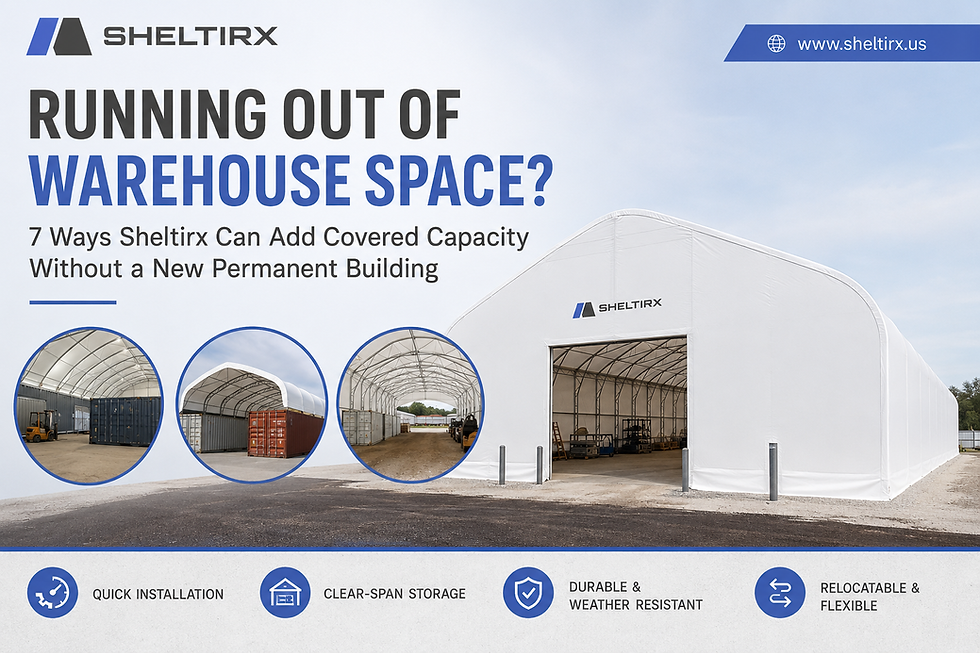
1. Add Clear-Span Storage Without Interior Columns
One of the biggest advantages of a fabric storage structure is that it can create a lot of covered floor space without filling the interior with conventional structural columns.
Take Sheltirx's 60ft Industrial Storage Shelter as an example. The listed configuration measures 60ft × 120ft × 25ft and provides 7,200 sq ft (670m²) of clear-span storage, with a 25ft eaves height. It's built with a double-truss galvanized steel frame and 900gsm fire-retardant PVC fabric.
That open interior is useful when you need space for equipment, vehicles, bulk materials, inventory, or anything else large enough that conventional interior obstructions would just get in the way.
The takeaway here: more capacity doesn't have to mean building another conventional warehouse. A purpose-designed fabric structure can deliver a substantial covered operational area while still keeping the flexibility that comes with modular construction.
2. Turn Existing Containers Into Covered Storage Areas
If your business already uses ISO shipping containers, you may not need to build a completely separate storage structure at all.
Sheltirx offers container canopy systems designed to create sheltered space around existing containers. In fact, the company specifically recommends container canopies for operators who already have ISO containers and need rapid, rugged cover with minimal groundworks.
The Sheltirx 40 × 20 ft Container Canopy, for instance, can be clamped or welded directly to containers, with alternative mounting options available for different site setups. It's also designed to be dismantled and relocated when operational needs change.
That opens up an interesting capacity strategy: rather than treating existing containers as isolated storage units, you can fold them into a larger sheltered storage arrangement.
For operations already built around containers, that's a practical way to add usable covered space without starting from scratch on a new building.
3. Create Temporary Warehouse Capacity When Demand Changes
Warehouse needs aren't always permanent.
A construction project might need extra storage for one phase. A logistics operation might see its inventory requirements shift. An industrial site might need temporary space while another facility gets upgraded.
Sheltirx describes its storage shelters specifically as temporary warehouse solutions for exactly these situations, when additional room is needed without permanent construction.
This kind of flexibility matters most when the real question isn't "how much warehouse space do we need overall?" but "how much covered space do we need right now?"
And because Sheltirx structures are built to be relocatable, that investment can stay useful even after a project wraps up or a site layout changes.
4. Expand or Reconfigure Covered Space as Operations Grow
Building too much space can waste money. Building too little can create its own headaches.
Sheltirx's fabric-building systems are designed with flexibility in mind from the start. The company says structures can be extended, reconfigured, or moved as requirements evolve. Its FAQ also notes that standard systems can be adjusted for spans, eave heights, and door openings, while Formex Bespoke is available for non-standard footprints or trickier sites.
In other words, covered capacity doesn't have to stay fixed.
You can treat additional space as an operational resource instead of a locked-in asset, and adapt the structure to the site as things change.
For businesses growing gradually rather than all at once, that adaptability can be a lot more appealing than committing to a fixed building footprint upfront.
5. Protect Equipment and Materials From Outdoor Exposure
Extra warehouse capacity isn't only about storing finished products.
Industrial operations often need covered areas for equipment, bulk materials, maintenance work, loading operations, or project supplies. Sheltirx lists applications including bulk material storage, equipment maintenance cover, loading canopies, site compounds, and temporary works.
Covered storage also gives you an alternative to leaving valuable assets sitting out in the weather.
Sheltirx structures use galvanized steel frameworks and fabric systems chosen for outdoor use. The company says its fabric buildings can use PVC, PVDF, or PTFE fabrics, and that its structures are engineered around the relevant site conditions.
The goal is simple: give equipment and materials a dedicated covered environment instead of leaving them exposed.
6. Use Natural Light to Make Covered Space More Functional
Adding storage space doesn't have to mean adding a dark, cave-like interior.
Sheltirx points to the energy-efficiency side of fabric structures, including translucent fabric that lets natural daylight into the building. The company says this can cut down on artificial lighting needs, and that its non-conductive membrane also helps regulate temperature.
That's worth thinking about when you're adding covered capacity.
A storage area needs to actually work for the people using it, whether they're moving equipment, pulling inventory, doing maintenance, or organizing materials. The interior environment matters just as much as the square footage.
So instead of thinking of a new structure purely as "extra space," it's worth considering how its design supports the day-to-day work happening inside it.
7. Add Capacity Without Giving Up the Ability to Relocate
Maybe the biggest difference between a traditional permanent building and a relocatable fabric structure is what happens when circumstances change.
Sheltirx describes its fabric buildings, container canopies, and storage shelters as relocatable solutions, systems designed to be dismantled and reinstalled so businesses can move covered infrastructure between sites as needs shift.
That's especially relevant for construction, infrastructure, logistics, agriculture, utilities, energy, and other industries where operations don't always stay put.
A permanent warehouse is tied to its original site forever. A relocatable structure can follow the work instead.
For companies still figuring out where future growth will happen, that's a meaningful difference.
What About Durability?
"Temporary" doesn't have to mean "lightweight" or "makeshift."
Sheltirx says its fabric structures are engineered to area-specific wind and snow loads and can be designed to meet local codes or the International Building Code (IBC). The company also notes its structures use hot-dip galvanized steel frameworks and engineered fabric systems.
Its Formex Bespoke range comes with a 20-year structural guarantee, a 10-year fabric guarantee, and a 5-year spare-parts warranty, subject to applicable terms and exclusions.
If you're researching Sheltirx reviews, these engineering, warranty, customization, and aftercare details are worth weighing alongside general customer opinions. Reviews offer useful perspective, but project-specific factors like site conditions, dimensions, anchoring, applicable codes, and intended use should be evaluated directly too.
Choosing the Right Sheltirx Approach
The right solution really comes down to what kind of capacity is missing.
Need a large open storage area? A clear-span fabric storage shelter might fit. Already have ISO containers on-site? A container canopy could make more sense. Dealing with an unusual footprint or specific site conditions? Sheltirx's Formex Bespoke option offers a more customized route.
Sheltirx also says its team can assess the site, project goals, and environmental conditions before developing a structural solution.
That makes the planning stage worth taking seriously. Before choosing a structure, it's worth working through the required width, length, height, access points, intended use, site conditions, and applicable engineering requirements.
A Different Way to Think About Warehouse Capacity
Running out of warehouse space doesn't automatically mean the next step is another permanent building.
Covered capacity can be approached a lot more strategically than that. A relocatable fabric structure can add storage. A container canopy can turn existing containers into part of a sheltered system. A clear-span storage shelter can provide substantial unobstructed floor space. Bespoke engineering can handle unusual footprints and site requirements.
For businesses that need more room but want to hold on to flexibility, these options sit somewhere between exposed outdoor storage and conventional permanent construction, and that middle ground is worth exploring.
The real question isn't just whether you need more warehouse space. It's how much covered capacity you need, how quickly you need it, what it has to accommodate, and whether today's requirements will even look the same tomorrow.
That's exactly where flexible fabric-building solutions from Sheltirx become worth a closer look.


Comments