


Why Sheltirx Fabric Buildings Are Changing the Way Businesses Think About Traditional Construction
- Sheltirx Fabric Building
- 5 days ago
- 6 min read

The Construction Decision Businesses Are Reconsidering: How Sheltirx Fabric Buildings Deliver Flexible, Engineered Space
For businesses that need more space, traditional construction isn't the only game in town anymore. Sure, a permanent steel, timber, or concrete building gives you plenty of room — but a lot of operations need something else too: faster installation, room to adapt when things change, lower ongoing costs, and a structure that's actually built for its environment.
That's where fabric buildings come in.
Sheltirx doesn't treat fabric structures as basic temporary shelters — it treats them as engineered building systems. Its Formex™ Bespoke fabric buildings are designed around the customer's site, purpose, and environmental conditions, with an engineering and fabrication process built to match specific operational needs.
If you're weighing your options for the next storage facility, workshop, logistics space, equipment shelter, or general operational space, that mix of flexibility and engineering is worth putting on the table as a real alternative to traditional building methods.
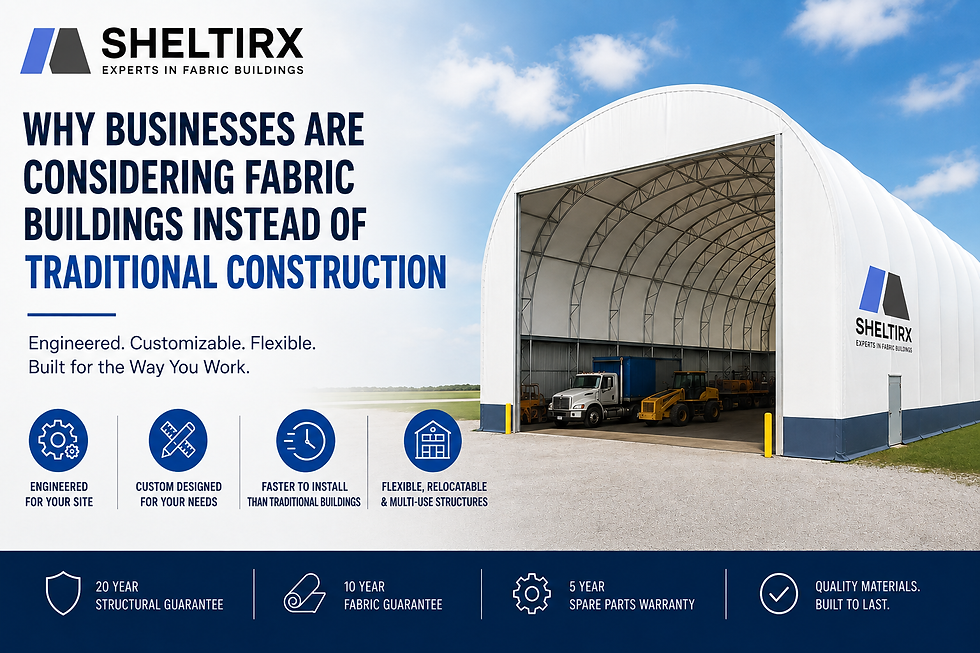
Traditional Construction Isn't Always the Flexible Choice
Here's one of the biggest differences between conventional construction and fabric buildings: what happens when your business changes.
A traditional building tends to get treated as a fixed, permanent asset. Once it's up, changing its size, configuration, or location can turn into a whole project of its own.
Sheltirx builds around a different philosophy. Its structures can be relocated, expanded, reconfigured, or redeployed as operational needs shift, and they can serve as temporary, semi-permanent, or long-term solutions, going up on a wide range of foundations.
That flexibility counts for a lot when your space needs aren't fixed in stone.
Maybe you need extra storage today, a bigger workshop tomorrow, and a different layout after that. Rather than locking yourself into one footprint, a fabric structure gives you room to adapt.
Speed Changes the Whole Equation
Time matters whenever a business needs more space — probably more than most people give it credit for.
Sheltirx builds its fabric buildings to go up faster than traditional steel or concrete structures. Once a project's approved, the process covers manufacturing, quality checks, delivery, and on-site setup.
But the process actually starts well before manufacturing even begins.
It opens with consultation — assessing the site, the project's goals, and the environmental conditions. From there, engineers develop the structure around those specifics, factoring in site challenges and whatever building requirements apply. Quotation and approval come next, followed by manufacturing, quality control, delivery, and installation.
Why does the end-to-end process matter so much? Because speed isn't just about slapping a structure up quickly — the design still has to account for the conditions the building will actually face once it's operating. And for a business, cutting down the time it takes to get usable space often means cutting down disruption to operations too.
Fabric Buildings Can Be Built Around Your Operation, Not the Other Way Around
There's a common misconception that fabric buildings mean picking a standard size off a list and adjusting your operations to fit it.
Sheltirx works the other way around.
Its Formex™ Bespoke structures are built from the ground up around the site, the purpose, and the environment. Sizes, colours, profiles, end walls, and mounting styles can all be adjusted, and the broader building lineup supports customization like span width, height, door placement, and lighting.
That turns the building into part of your operational planning, not just a box you fit your operations into.
Access needs can shape where the doors go. Equipment needs can shape the height. The site itself can shape the structural design. So the consultation and design process isn't really about picking a product off a shelf — it's about figuring out how the structure needs to actually function for you.
Engineering Still Sits at the Center of It All
Flexibility doesn't mean cutting corners on structural planning.
Sheltirx engineers its fabric buildings to handle area-specific wind and snow loads, and they can be designed to meet local building codes or the International Building Code (IBC). Wind, snow, and site conditions all factor into the design from the start.
On the materials side, Sheltirx uses premium SHS steel and high-tensile fabric systems, with hot-dip galvanised steel frames protecting against rust and corrosion, plus PVC, PVDF, and PTFE fabric options.
This engineering-first mindset is really what separates an engineered fabric building from the idea of a basic pop-up shelter. The goal isn't just to cover a piece of ground — it's to build something designed specifically for its application and environment.
Lifetime Costs Can Matter More Than the Initial Build
It's easy to focus on the upfront price tag when evaluating construction, but the lifetime cost of a building deserves just as much attention.
Sheltirx points out that fabric buildings can come in more economical than traditional steel or timber construction — lightweight materials mean less labour, and installation moves faster. Reduced lighting and HVAC demand can also help keep ongoing running costs down.
This is where the fabric membrane gets genuinely interesting.
Translucent fabric lets natural daylight into the building, cutting down on artificial lighting. The non-conductive membrane also helps regulate temperature — staying cooler in summer, warmer in winter — which can ease heating and cooling demands too.
For a business running a large space, those operational details can add up to something meaningful over the life of the building.
Maintenance Is Part of the Decision Too
Construction decisions don't end the moment installation wraps up.
A building still has to stay functional and manageable for years afterward. Sheltirx's fabric covers typically last 15–20 years before needing repairs, while the galvanised steel frameworks can hold up for decades — and compared to traditional buildings, the maintenance requirements stay pretty minimal.
The materials aren't chosen at random, either. Hot-dip galvanised steel and high-quality fabric systems are selected specifically with durability in mind, built for years — often decades — of reliable performance.
That gives businesses another angle to weigh: not just how fast the space can go up, but how well it holds up once it's there.
A Fabric Building Can Move With Your Business
Business needs shift. That's just how it goes.
A facility might expand. Operations might relocate. Storage needs might grow or shrink. What starts as a temporary fix might turn into something long-term.
Sheltirx builds its fabric structures to be multi-use and relocatable — they can expand, move, or get redeployed as operations change, supporting everything from storage and workshops to equipment protection, logistics, and seasonal work.
That's especially useful if you don't want every dollar spent on physical space to be permanently tied to one location or one configuration. Instead, the structure gives you a level of adaptability that conventional permanent construction just doesn't offer as easily.
Sustainability Is Part of the Picture Too
There's an environmental angle worth considering here as well.
Fabric buildings use fewer raw materials and take less energy to manufacture, and many components can be reused or recycled — which can shrink the structure's environmental footprint over its lifespan.
Add in the natural daylight and the potential for lower heating and cooling needs, and the building design ends up addressing both the construction side and the day-to-day operational side.
For businesses thinking about the long-term impact of their facilities, that broader view can be genuinely useful.
Why Businesses Are Looking Past the Conventional Building Model
At the end of the day, the choice between traditional construction and a fabric building comes down to what the project actually needs.
But the case for an engineered fabric structure keeps getting harder to ignore.
Businesses want space that goes up fast, adapts easily, can be relocated, gets customized to their specific operations, and is designed around the actual environmental conditions on site. Maintenance, energy use, and lifetime cost matter too — not just the construction method itself.
Sheltirx brings all of that together through an end-to-end process: consultation, engineering, quotation, manufacturing, quality control, delivery, installation, and handover. And it backs its structures with a 20-year structural guarantee, a 10-year fabric guarantee, and a 5-year spare-parts warranty.
That changes the question businesses should really be asking. Instead of "Should we build another traditional building?" — maybe the better question is:
What type of structure actually fits how our business operates today, and how it might need to operate tomorrow?
For organizations that value flexibility, engineered design, fast installation, energy efficiency, and the ability to adapt as things change, a Sheltirx fabric building is worth putting on the shortlist.

Comments